Meeting and Death of Neville and the Surviving Dog
I Am LegendRobert Neville’s encounter with the surviving dog is a brief, decisive episode in the ruined world of the novel: a living animal appears in daylight, becomes the focus of his desperate hope for companionship, and then dies despite his attempt to protect it. The dog is not merely a consolation for Robert Neville. Its movement through the infected environment makes it a biological mystery, a possible victim, and a vulnerable relationship that forces him to confront care, uncertainty, and repeated bereavement.
A Living Sign in the Daylight
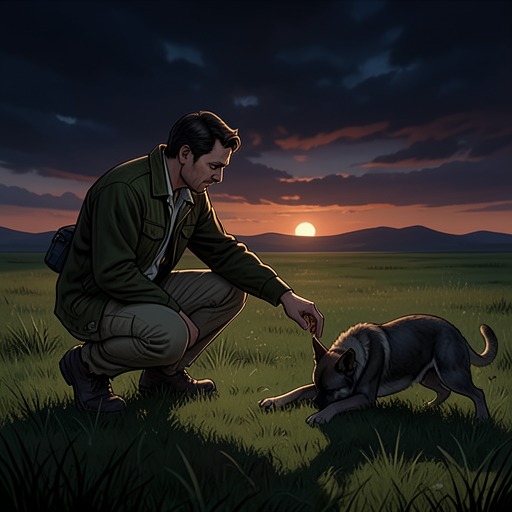
The encounter begins on the third morning after Robert Neville has buried Virginia Neville and fallen into prolonged drunkenness. When he stumbles onto the porch, he sees a dog roaming across the lawn. The sight is shocking because the animal is alive in daylight, apparently moving through the very hours in which the vampires are constrained. The dog is scrawny, limping, and frightened; as soon as it hears the front door, it jerks up its head and bounds away with its tail drawn between its legs. Robert Neville nevertheless runs after it across Cimarron Street, calling for it to return.
The failed pursuit intensifies rather than diminishes the animal’s importance. Robert Neville searches the neighborhood for an hour, calling repeatedly, then searches again in the afternoon through yards, streets, and individual houses. He cannot eat or sleep and keeps muttering that the dog should come back, promising that he will not hurt it. His response makes clear that the dog has become more than an accidental sighting. After the deaths and returns surrounding Virginia Neville and Kathy Neville, the animal represents the possibility of an uninfected—or at least still living—companion in a world otherwise organized around corpses, threats, and silence.
Testing Trust and Infection
Robert Neville tries to lure the dog without forcing an immediate confrontation. He leaves out milk and hamburger and surrounds the food with garlic bulbs, hoping that the vampires will not touch it. The precaution reveals the conflict between his practical knowledge and his emotional need: garlic may protect the food from vampires, but it may also repel the dog if the dog carries the germ. He reasons that the animal could have received only a small dose of bacilli, enough to remain mobile in daylight without yet being fully affected, but that possibility raises a further danger. If the dog survives the day but is vulnerable at night, the vampires may kill it before Robert Neville can help.
The next morning, the food is gone, while two women lie crumpled on the lawn and the dog is absent. Robert Neville feels relief that the animal has escaped, but he also reproaches himself for having been asleep when it came. He imagines that the dog may have evolved a way to survive, perhaps by approaching only after dawn, and recognizes that his own failure to observe the moment has left the central question unanswered. The dog thus becomes part of his investigation of the epidemic: its behavior may disclose how infection operates across species, yet the urgency of the possible experiment is inseparable from the animal’s suffering.
The dog returns at four o’clock, hobbling across the street with cautious, white-rimmed eyes. Robert Neville remains behind the peephole and watches it eat. The scene gives him an unfamiliar sense of warmth and normality; the dog’s slurping and snapping jaws restore, for a moment, the ordinary rhythm of feeding and companionship. He wants to repair its injured paw and win its affection, but he understands that a sudden movement could destroy the fragile trust developing between them. For several days he goes onto the porch after the dog finishes eating. Each time the dog runs away, yet it gradually slows, stops halfway across the street, looks back, and barks. Their repeated approach-and-retreat becomes a cautious game in which Robert Neville learns that restraint, rather than pursuit, is the only method by which the animal may come closer.
Rescue and the Night of Fear
Eventually Robert Neville sits on the porch before the dog arrives and remains still when it appears. The dog hesitates near the curb, watching him and the food in turn, while even the accidental crossing of his legs makes it shrink away. Robert Neville edges farther from the meal and keeps his body quiet, allowing the dog to choose the distance between them. The encounter gives the dog a limited agency within the scene: it is frightened and sick, but it is not simply captured by the human will.
When the dog finally comes within reach, Robert Neville waits until late afternoon and then picks it up. The animal snaps at him, and he must hold its jaws together, but its lean, nearly hairless body can offer only weak resistance. Its terrified whines show that rescue is experienced as another threat. Robert Neville carries it home and speaks reassuringly, yet the deeper crisis comes when night falls. The dog backs into a corner, raises its hackles, bares its yellowish-white teeth, and tries to dig into the floor. Robert Neville realizes that it is attempting to bury itself, a response to the nocturnal condition that governs the vampires and perhaps the infected animal as well.
He covers the dog with the top blanket from his bed, creating a dark shelter beneath the workbench. At first the dog recoils from his hand and snaps, but his quiet talk gradually allows physical contact. He strokes and scratches its warm neck, and the sick animal licks his palm. Robert Neville cries while holding it, not because the rescue has succeeded, but because the gesture briefly establishes reciprocal trust between two frightened survivors. The tenderness is inseparable from foreknowledge: the dog’s dulled, diseased eyes already suggest that care may not be enough.
Death and Aftermath
The dog dies within a week. Its death repeats the structure of Robert Neville’s earlier losses: hope forms around a living presence, the presence becomes an object of protection, and the attempt to preserve it ends in helplessness. The episode does not provide Robert Neville with a companion or a cure. Instead, it gives him direct evidence that survival in daylight does not guarantee freedom from the disease, and that the infected world can pass through boundaries between human and animal life.
The aftermath changes Robert Neville’s behavior. He does not respond with another prolonged debauch of drinking; in fact, he drinks less. He concludes that the earlier drunken period had taken him to the bottom of despair, so that the only remaining direction was upward unless he deliberately destroyed himself. The dog’s death therefore becomes a limit he can recognize rather than another occasion for denial. The intense hope he had invested in the animal comes to seem as dangerous as the horror itself, because wild dreaming cannot save anyone in a world whose greater enemy is monotonous, unending terror.
After burying the dog, Robert Neville accepts the confinement of his existence more quietly. He no longer tries to escape it through reckless gestures or to batter himself against its walls. He returns to work, carrying forward the investigation that the dog’s behavior had sharpened but could not complete. The animal’s death strips away a false promise of rescue while leaving behind a harder form of endurance: Robert Neville continues not because the world has become hopeful, but because hope has been separated from survival.
Narrative Significance
The episode links several systems that Robert Neville has tried to keep distinct. Mosquitoes and flies can mechanically disseminate bacterial disease, and the dog’s presence shows that the epidemic is not confined to human bodies. Garlic, which Robert Neville uses as a defensive barrier, becomes ambiguous when it may protect him from vampires while preventing the dog from reaching food. Daylight, ordinarily a sign of safety, proves only conditionally protective. The dog can move outside during the day and still display the night-bound terror of an infected creature.
At the same time, the dog becomes a measure of Robert Neville’s emotional condition. His earlier grief over Virginia Neville includes recurring dreams and traumatic memories of Kathy Neville’s death and Virginia Neville’s return. Against that history, the dog offers a substitute attachment, but not a replacement that can erase the dead. Robert Neville’s pursuit, waiting, capture, sheltering, and grieving show him moving from frantic possession toward a more difficult form of care—one that must acknowledge the animal’s fear and bodily vulnerability. When the dog dies, the failure is not simply personal. It exposes the limits of human control within the plague ecology and forces Robert Neville to resume his work with less illusion, but also with a newly clarified understanding of what survival costs.